The kontusz sash is Polish and Turkish at once. Worn by the nobility of the Commonwealth, woven after Persian patterns, decorated with tulip motifs from the Topkapı Palace. When the Museum of the Mazovian Nobility in Ciechanów invited us to create the visual setting for an exhibition on Turkish influences in Sarmatian culture, we knew that this one object – two-sided, two-coloured, two cultures in one – would say more than any curatorial manifesto. We made it the key to the entire identity.
An anniversary where two worlds meet
Three anniversaries fell together in 2023: the fiftieth of the Museum of the Mazovian Nobility in Ciechanów (Muzeum Szlachty Mazowieckiej), the centenary of the proclamation of the Republic of Turkey, and the centenary of the signing of the Treaty of Friendship between Poland and Turkey. The curator, Nina Matczak, decided to use this convergence of dates to tell a story that is rarely told: that in Polish–Turkish relations there has been more peace than war. And that it was precisely the peaceful contacts – diplomatic, commercial, cultural – that left a deeper mark on Poland than any battle.
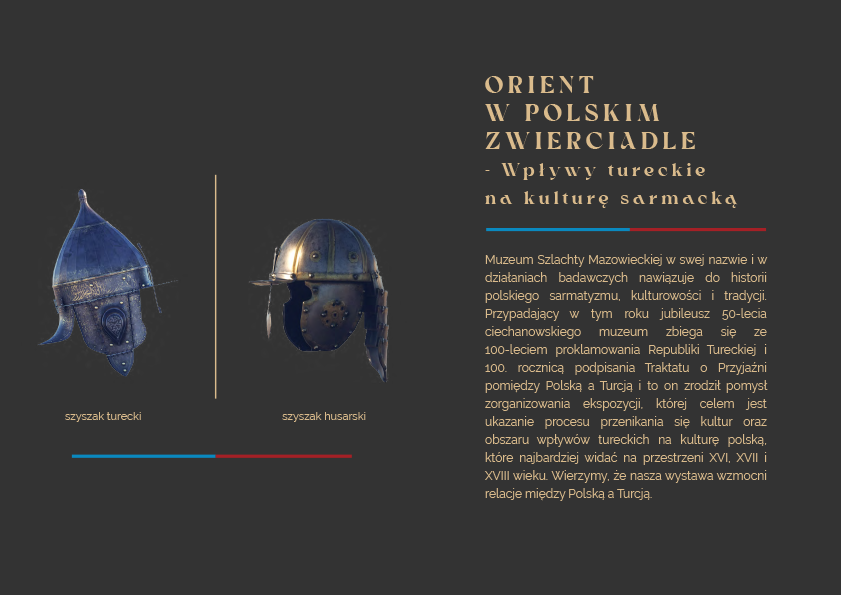
The exhibition “The Orient in the Polish Mirror – Turkish Influences on Sarmatian Culture” took over the rooms of the Aleksandra Bąkowska Manor House (Dworek Aleksandry Bąkowskiej) in Gołotczyzna. Exhibits from more than twenty institutions – from the Wawel Royal Castle and the National Museum in Kraków to the Topkapı Palace in Istanbul – and from private collections. Our role: to turn these rooms into a space that does not merely display, but tells a story.
The mirror as a design principle
The exhibition title we proposed hinges on the word “mirror” (zwierciadło in the original), and that word became the key to the entire visual identity. The motif of reflection – what is Polish seen in what is Turkish, and the other way round – runs through every element of the graphic design. Posters, banners, the catalogue, room signage, exhibit labels – all of it built on the principle of duality.
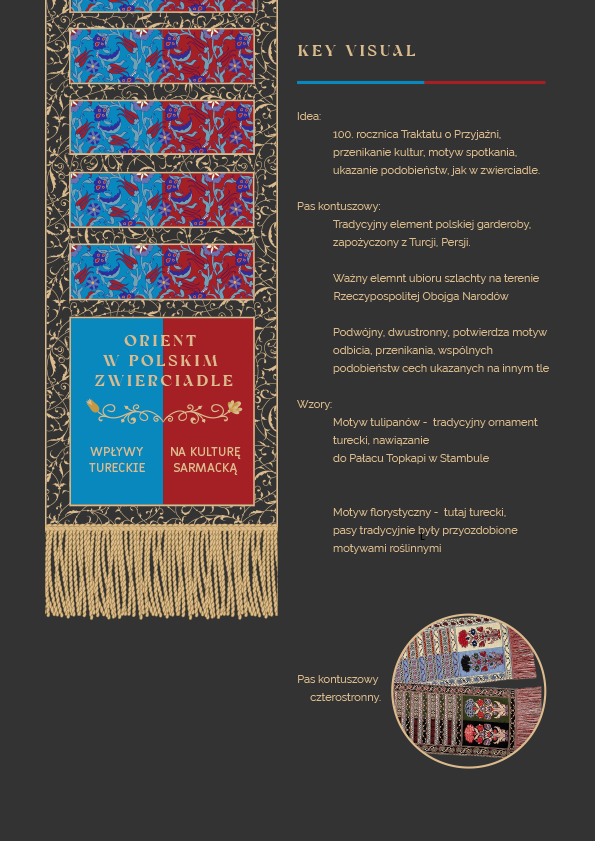
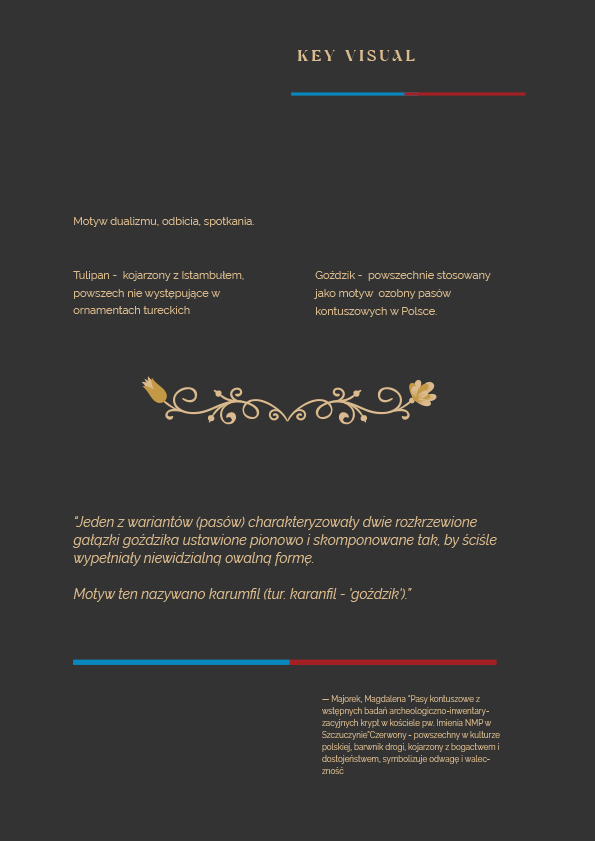
At the centre of the key visual is the kontusz sash. A traditional element of the Polish nobleman's dress, borrowed from Turkey and Persia. Two-sided – which makes the motif of reflection quite literal. Double, two-coloured, carrying both cultures within itself at once. Two motifs meet on the sash: the tulip – associated with Istanbul, ubiquitous in Turkish ornament – and the carnation, known in Turkish as karanfil, one of the most frequent motifs on Polish kontusz sashes.
One variant of the sash was distinguished by two branching sprigs of carnation, set vertically and composed so as to fill an invisible oval form exactly. The motif was known as karanfil.
A palette that speaks
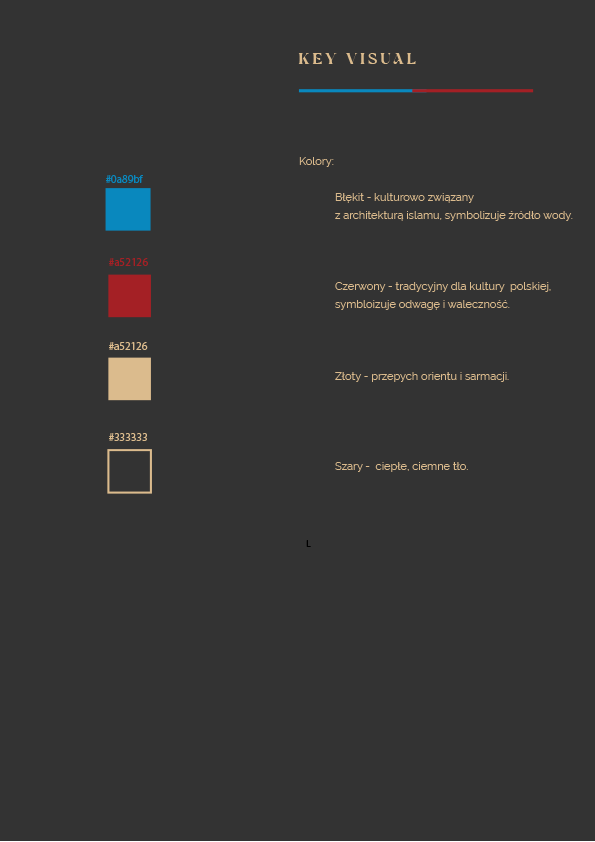
Nothing about the exhibition's colours is accidental – each one carries meaning. Blue, culturally bound to the architecture of Islam, stands for the wellspring of water and the endless sky above the mosques. Red – traditional in Polish culture, a costly dye associated with wealth and dignity – stands for courage and valour. Gold joins the two worlds: the splendour of the Orient and the Sarmatian love of magnificence. All of it set against a warm, dark ground – a grey that does not dominate, but binds.
These four colours run through the whole exhibition: from the large-format graphics on the walls, through the typography of the labels, to the lighting of the rooms. Visual coherence is a challenge in a space where the exhibits come from so many different eras and collections – but a consistent palette creates a frame within which even the most disparate objects begin to talk to one another.
A space that changes
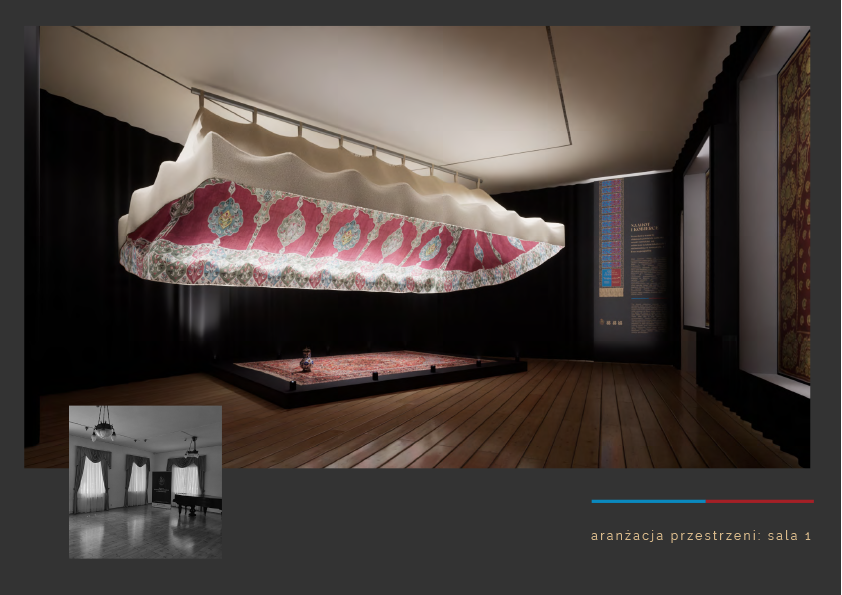
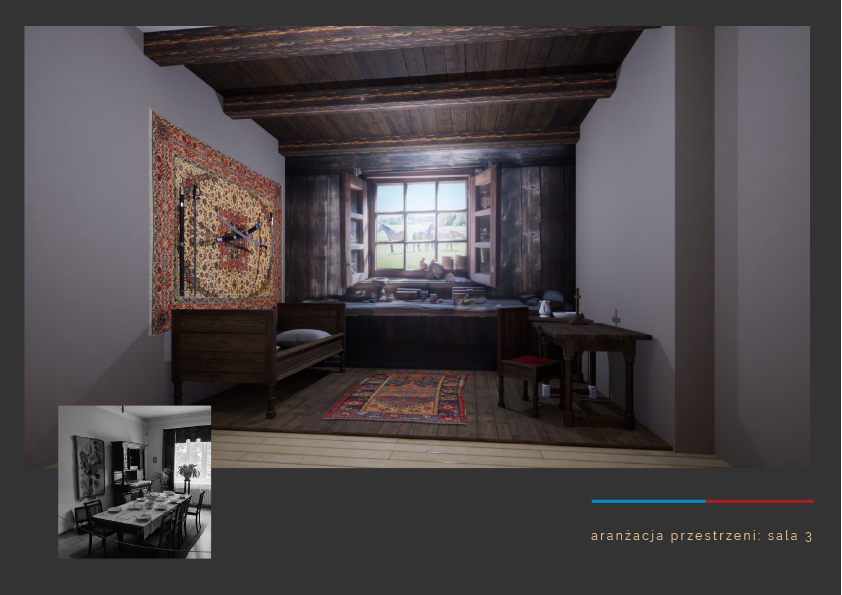
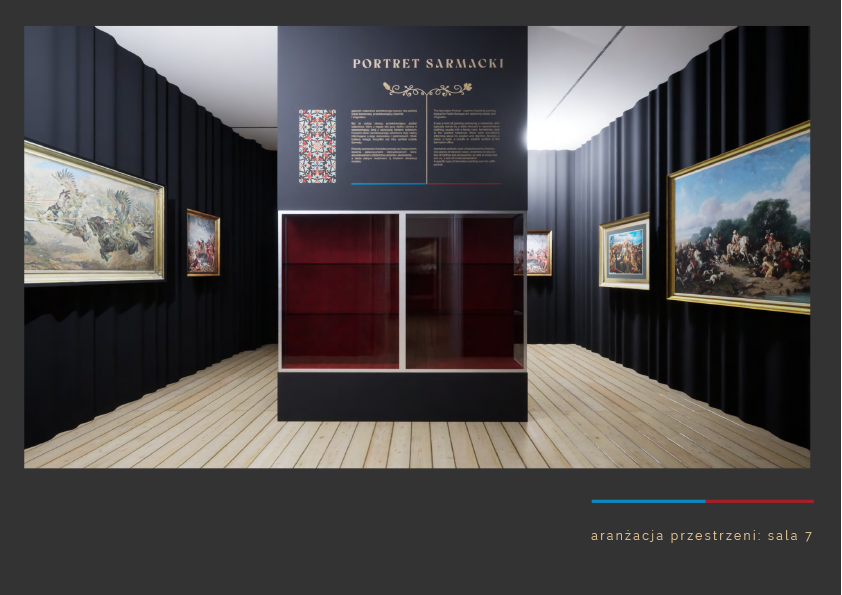
We worked with the architect Piotr Królik on the spatial concept. The Aleksandra Bąkowska Manor House is a building with a history and a character of its own – it cannot be treated as a white box. Several rooms were completely transformed for the duration of the exhibition: altered proportions, new divisions, layers of fabric and graphics that turn nineteenth-century drawing rooms into passageways between the Commonwealth and the Ottoman Empire.
The exhibition design had to reconcile exhibits of utterly different scale – from tiny coins to large-format textiles and militaria. Each room has its own rhythm and temperature, but all of them are joined by the same visual story. Moving from room to room is moving between chapters – not jumping from one display case to the next.
Sound, image, touch
The visual setting is only the beginning. We produced video material that complements the exhibition's narrative – not replacing it, but adding a layer that static exhibits cannot provide: movement, context, scale. Sound design builds the atmosphere of the individual rooms – subtle, unobtrusive, but present. Because an exhibition about three centuries of cultural exchange cannot be silent.
On the info kiosk we launched an application that lets visitors go deeper into the detail – magnify the ornament of a kontusz sash, compare a Turkish original with its Polish adaptation, read about the loanwords of which Polish has a great many: from “kawa” (coffee) to “dywan” (carpet), from “turban” to “jarczak” (a light cavalry saddle). The interface is simple – because nobody in a museum wants to read a user manual.
Twenty collections, one story
The exhibition brought together objects from the Wawel Royal Castle, the Royal Castle in Warsaw, the Polish Army Museum, the National Museum in Kraków, museums in Kielce, Lublin, Poznań and Wrocław, the Museum of Warsaw, the Ossolineum, the University of Warsaw Library, as well as photographs from the Topkapı Palace in Istanbul. More than twenty institutions and private collectors. Every exhibit with a different history, a different provenance, a different context – and all of them had to find their place in a single, coherent narrative.
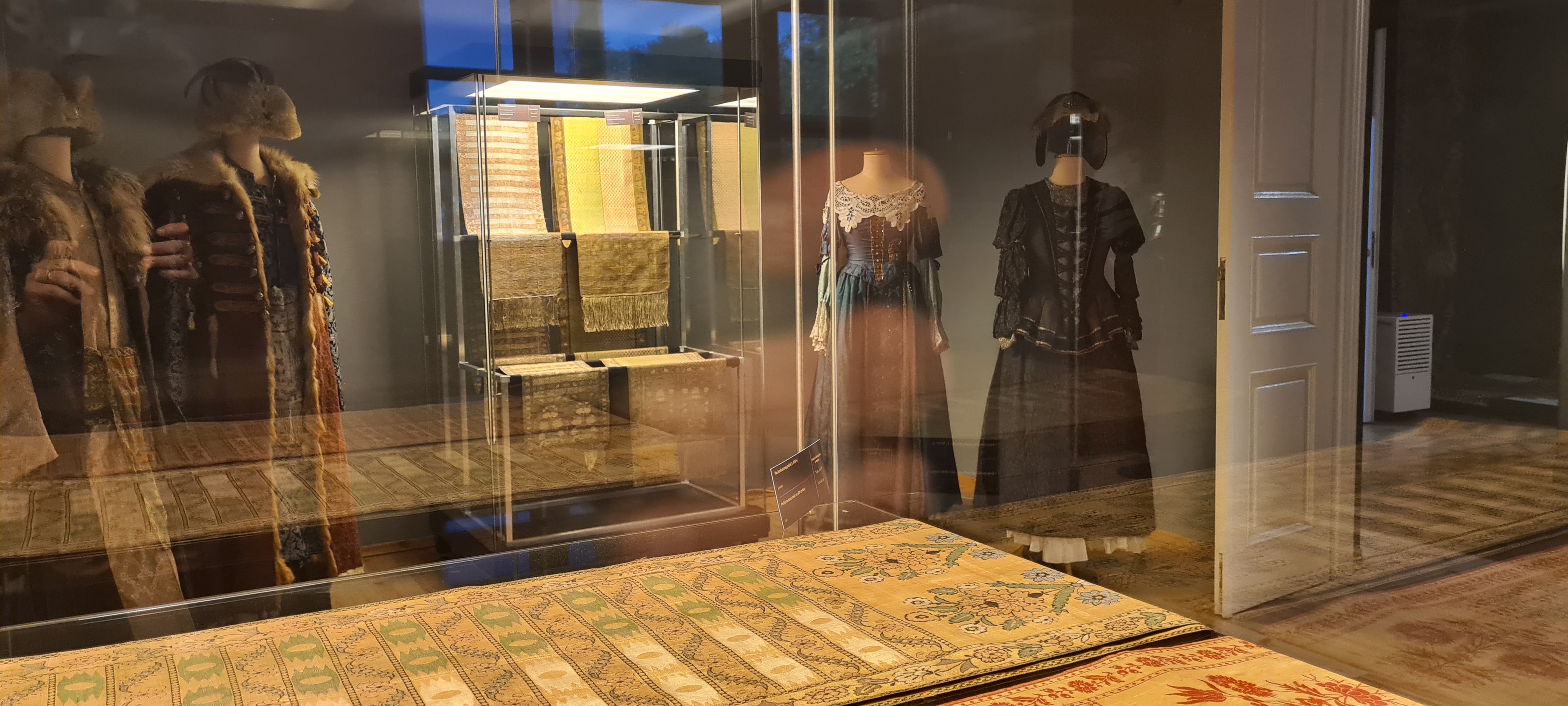
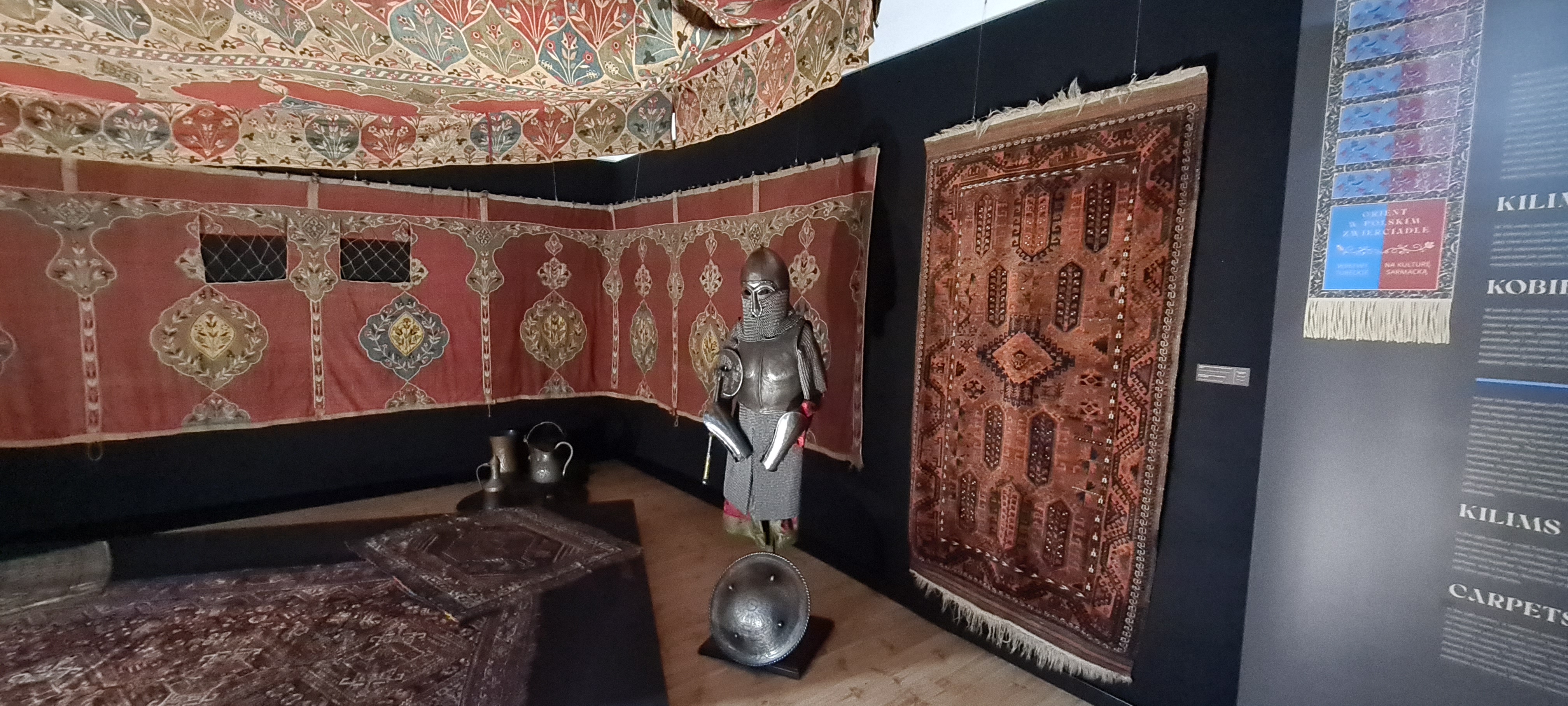
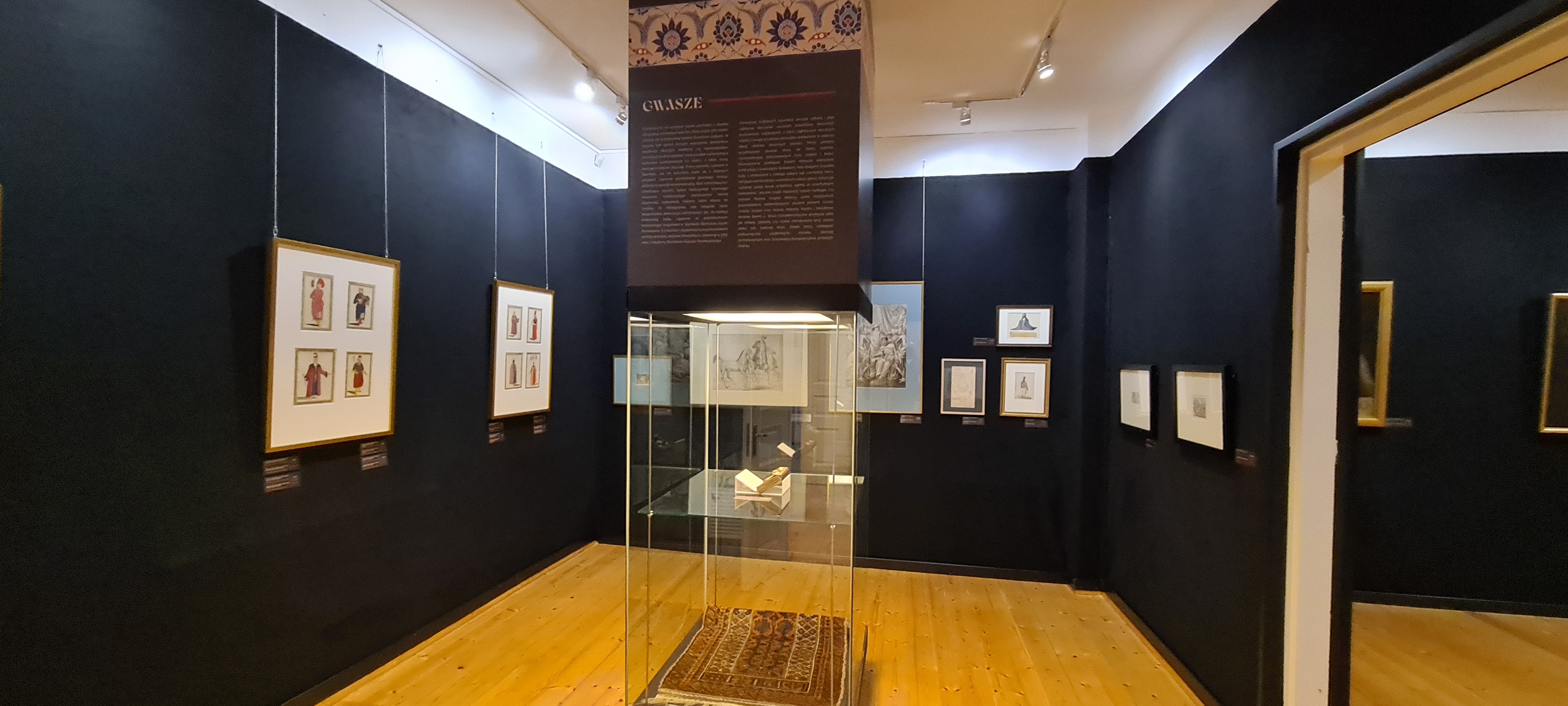
This is the heart of what we do: we do not make exhibits – we make the space in which exhibits begin to speak. Visual identity, exhibition design, multimedia, sound – these are tools. The story is the aim. And this particular story – of two cultures that fought and traded for centuries, prayed to different gods and wore the same sashes – seems to us especially timely.