Beneath the headquarters of the National Bank of Poland on Świętokrzyska Street lies the Money Centre – one of the most modern exhibition centres in Poland. Among its dozens of multimedia installations there is one that is hard to call an exhibit, because it does not stand behind glass and has no label. It is the sky. Artificial, controlled, responsive – yet looking as though someone had cut out a piece of the atmosphere and fitted it into the ceiling. We wrote the application that governs this sky.
A street where the rain never falls
The NBP Money Centre (Centrum Pieniądza NBP) covers more than two thousand square metres and houses sixteen themed rooms – from ancient coins to stock-market simulations. One of its most recognisable spaces is the reconstruction of a historic banking street: shopfronts, signboards, cobblestones, street lamps. All of it recreated with a level of detail that makes you forget you are underground.
The trouble was that the street needed a sky. Not a metaphorical one – a literal one. The vault overhead had to live: to change through the day, to respond to the season, to set a mood. An enclosed underground space has no windows. They had to be created – above the visitors' heads.
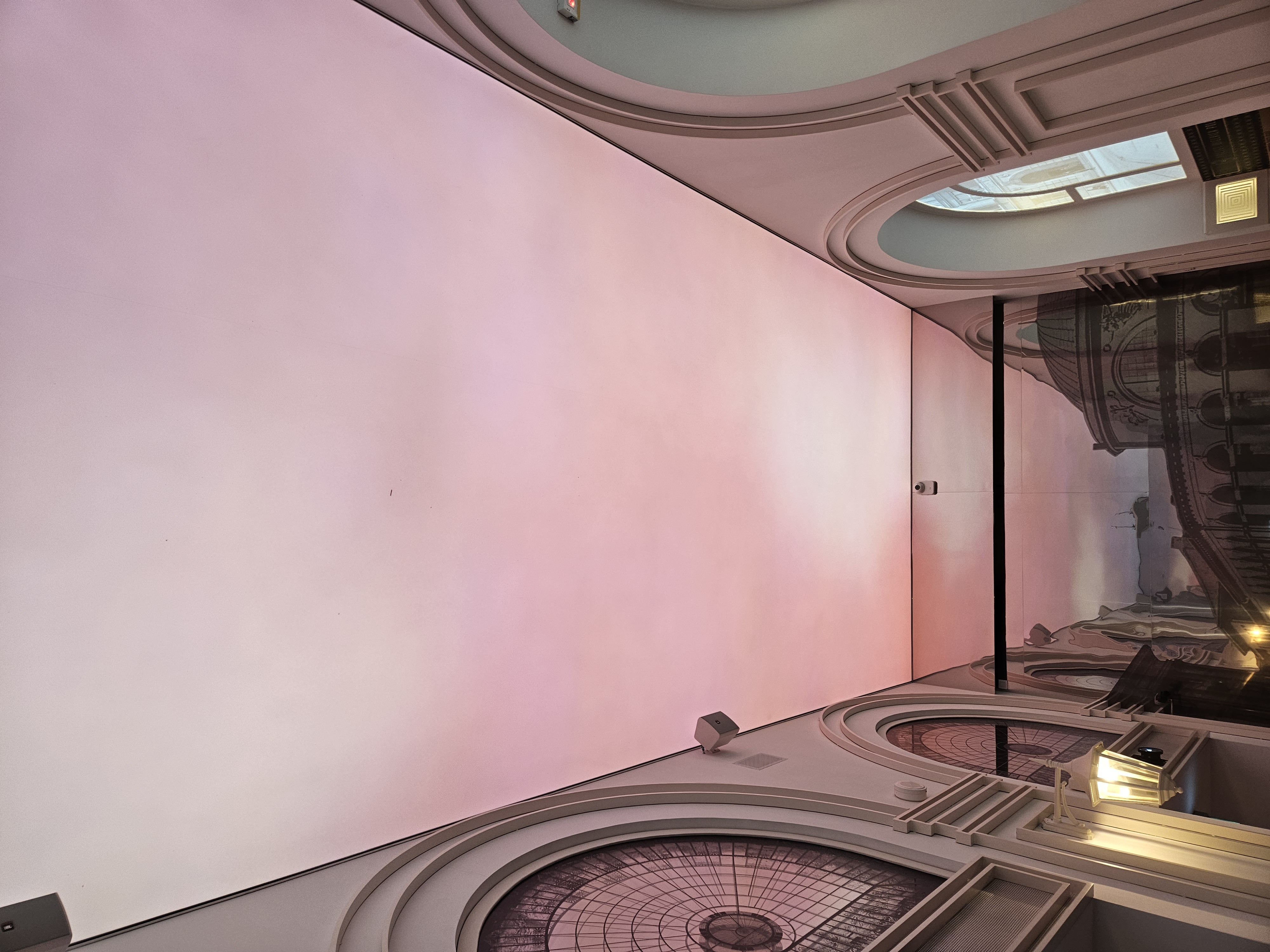
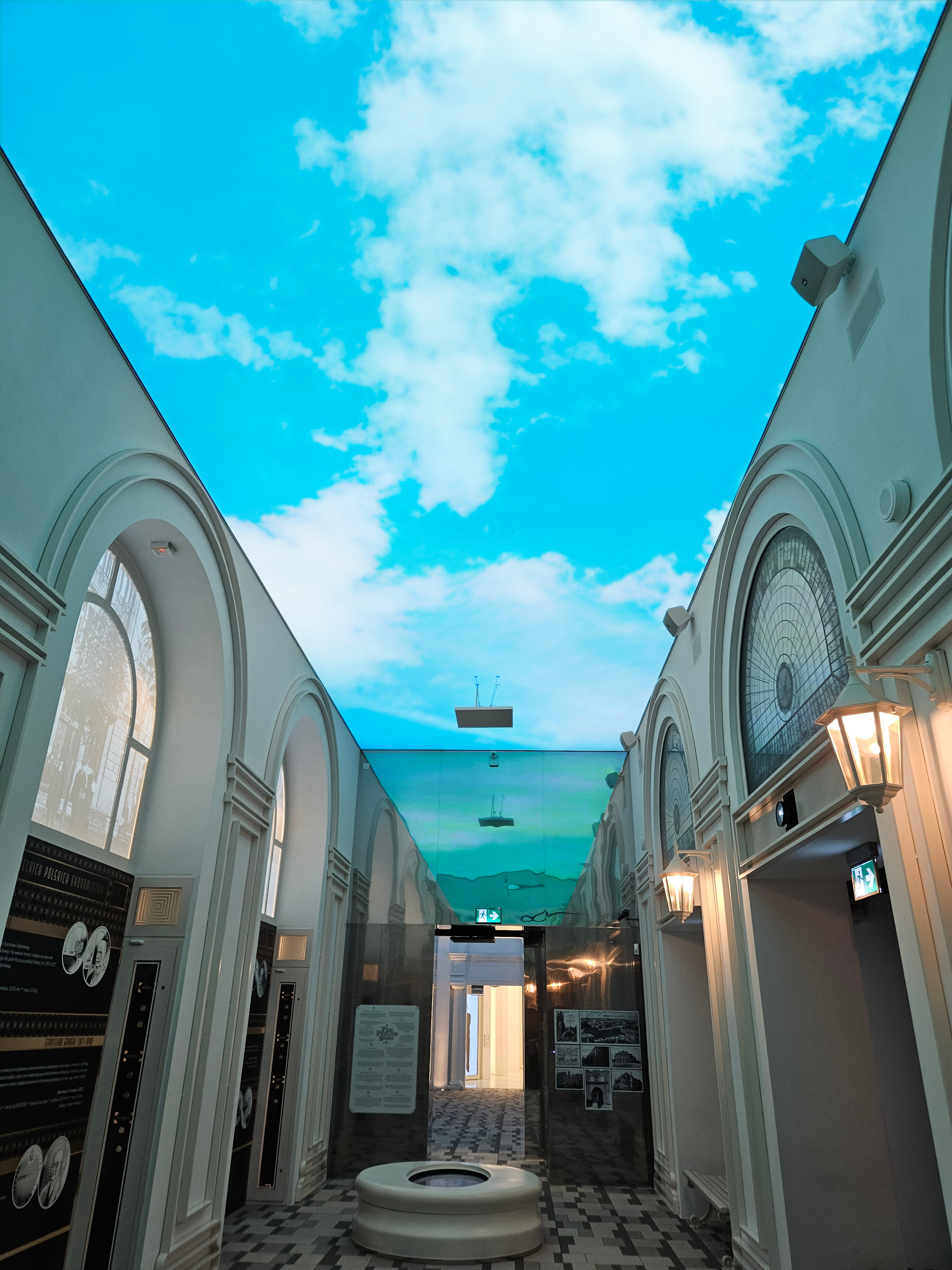
Barrisol Lumière – a membrane that breathes light
The material that made it possible is Barrisol Lumière – a special membrane with exceptional light-transmitting properties. Light passing through it is diffused so thoroughly that it casts no shadows. The effect is as if the air itself were glowing. Behind the membrane sits a matrix of RGB LEDs, allowing full control of the colour, intensity and distribution of light across the entire surface of the ceiling.
This is not a backlit panel. It is a canvas on which we paint the sky – clouds, the glow of morning, the golden hour, the grey before a storm, the deep blue of night. Every pixel individually, every shade from a palette limited only by the physics of the diode.
The hardest part of the whole project was not controlling the diodes. The hardest part was getting people to lift their heads, look up at the ceiling and forget, for a moment, that they were standing underground.
The daily cycle
Our application runs the sky through a twenty-four-hour cycle. Morning – pastel blues with a soft glow from the east. Noon – a bright, saturated sky with a few scattered clouds. Afternoon – warmer tones, longer cloud shadows. Evening – a gradient passing through oranges and violets. Night – a deep navy with subtle points of light.
The cycle is not rigid. The application allows the cloud density to be adjusted – from a cloudless azure to heavy, low-hanging cumulus. The speed at which the clouds drift across the ceiling is a parameter too: from a light breeze to a gale that gives the space a sense of movement. Everything fluid, everything animated, everything looking natural – though behind every pixel there is an algorithm.
The control panel
The sky is controlled from a touchscreen mounted in a technical room. We designed the interface so that the Centre's staff can change the mood of the sky in a few seconds – without calling IT, without reading a manual. Sliders: cloud density, wind speed, time of day, colour saturation. Presets: clear morning, sunset, night, storm. One touch – and the sky changes.
There is also a manual mode for those who want to paint the sky themselves. Full control over every LED parameter: RGB colour, brightness, gradient, direction of transition. It is a tool for set designers and lighting operators, not for the casual user – but it is there, because every exhibition space has moments when it needs light that is out of the ordinary.
Studio mode
The Money Centre regularly opens the banking street for the recording of interviews, promotional material and television reports. The artificial sky in the background – with suitably chosen lighting – serves as a film set that no studio could reproduce. Hence the application's studio mode: constant, even illumination at a controlled colour temperature, with no cloud animation and no change over time. A clean, calm sky that does not distract from the speaker, but gives the frame depth and character.
Technology that stays out of sight
All the electronics – LED drivers, power supplies, cabling – are hidden behind the Barrisol membrane. The visitor sees only the effect: a sky that changes. They do not see the LEDs, the controllers, the diffusion layers, the colour-interpolation algorithms. And that is how it should be. The best exhibition technology is the kind that disappears – leaving only the experience.
The application has run without interruption since the Centre opened. The daily cycle counts off the hours, the clouds wander across the ceiling, the sky darkens and brightens – whether or not anyone is watching. Because the real sky does not wait for an audience either.